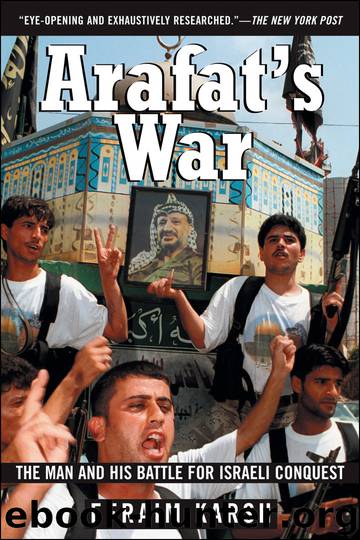
Arafat's War by Efraim Karsh
Author:Efraim Karsh
Language: eng
Format: epub
Publisher: Grove/Atlantic, Inc.
Published: 2003-07-18T16:00:00+00:00
In January 1997 the Netanyahu government signed the Hebron Protocol, stipulating the redeployment of the IDF from the last major Palestinian town, something that the previous government had failed to do. It was a move that subjected Netanyahu to harsh criticism within his own camp. Yet the further withdrawal of Israeli forces from the West Bank (pullback from Gaza had been completed in May 1994) proved far more problematic as Netanyahu sought to transfer the minimum possible territory to the PA before the conclusion of the final-status agreement.
The September 1995 Interim Agreement divided the West Bank into three distinct areas in accordance with the degree of Palestinian sovereignty: Area A, namely the Jericho area and the seven main Palestinian cities of Jenin, Nablus, Tulkarm, Qalqilya, Ramallah, Bethlehem, and Hebron, which was to be under complete Palestinian control; Area B, comprising some 450 towns, villages, refugee camps, and hamlets, where the Palestinian Authority was to exercise civil authority and to protect the “public order for Palestinians” while Israel would maintain “overriding responsibility for security for the purpose of protecting Israelis and confronting the threat of terrorism”; and Area C, where Israel was to retain complete territorial jurisdiction with the Palestinian Authority maintaining “functional jurisdiction” over the Arab population in matters “not related to territory.”
In accordance with the agreement, by the end of 1995 Israeli forces had been withdrawn from Areas A and B (with the exception of Hebron). This amounted to nearly 30 percent of the West Bank’s overall territory and virtually its entire Palestinian population, which now came under the reign of the newly established Palestinian Authority.26 On January 20, 1996, elections to the Palestinian Legislative Council were held, and shortly afterward the Israeli civil administration and military government were dissolved.
The further redeployment of Israeli forces “to specified military locations,” as well as the transfer of internal-security responsibility in the various areas, was to be “gradually implemented in accordance with the DOP in three phases, each to take place after an interval of six months, after the inauguration of the [Palestinian Legislative] Council, to be completed within 18 months from the date of the inauguration of the Council.”27
Since this timetable committed Israel to the withdrawal of its troops from most of the West Bank by September 1997, a year and a half before the conclusion of the permanent-status negotiations, it was widely resented by security people, including former prime minister Rabin, who had feared that once Israel surrendered its territorial assets it would be unable to ensure that the Palestinians would keep their part to the bargain.28 For Netanyahu, whose long-standing conviction was that Arafat sought to transform the West Bank into a springboard for an assault on Israel in keeping with the PLO’s so-called phased strategy, this timetable was nothing short of a disaster.
Netanyahu thus sought to extend the timetable as far as possible and tried to tie it to Palestinian compliance with the peace accords in the form of a Note for the Record, prepared by U.S. peace mediator Dennis Ross and appended to the Hebron Protocol.
Download
This site does not store any files on its server. We only index and link to content provided by other sites. Please contact the content providers to delete copyright contents if any and email us, we'll remove relevant links or contents immediately.
| Anthropology | Archaeology |
| Philosophy | Politics & Government |
| Social Sciences | Sociology |
| Women's Studies |
The Secret History by Donna Tartt(19083)
The Social Justice Warrior Handbook by Lisa De Pasquale(12190)
Thirteen Reasons Why by Jay Asher(8907)
This Is How You Lose Her by Junot Diaz(6885)
Weapons of Math Destruction by Cathy O'Neil(6279)
Zero to One by Peter Thiel(5799)
Beartown by Fredrik Backman(5751)
The Myth of the Strong Leader by Archie Brown(5507)
The Fire Next Time by James Baldwin(5441)
How Democracies Die by Steven Levitsky & Daniel Ziblatt(5218)
Promise Me, Dad by Joe Biden(5153)
Stone's Rules by Roger Stone(5087)
A Higher Loyalty: Truth, Lies, and Leadership by James Comey(4959)
100 Deadly Skills by Clint Emerson(4924)
Rise and Kill First by Ronen Bergman(4788)
Secrecy World by Jake Bernstein(4751)
The David Icke Guide to the Global Conspiracy (and how to end it) by David Icke(4717)
The Farm by Tom Rob Smith(4506)
The Doomsday Machine by Daniel Ellsberg(4490)
